
As I write this, Naomi and I are on our return flight to JFK. We have experienced so much the past two months that I could write a book, but I will try to just recount the highlights.

We left the U.S. back in January. Our destination was on the Kenya Uganda border to a small village named Amagaro. This is considered the end of the earth by Kenyans and seemed forgotten by the rest of the world as well. We would not see another muzungu (white person) the whole time we were there. It was clear by the reaction of some children that they had never seen a white person before. We saw some children cry, others covered their eyes, and one boy, after shaking Naomi’s hand, looked at his hand as if it was going to turn white.
Despite our skin color, we received a very warm welcome. Not only did we hear many in the village say welcome home, but we also heard them complain how hot it was. As you can imagine, if they were complaining about the temperature, we also found it unbearable. And we spent many nights sweating under a mosquito net trying to get some sleep.
Not only was it hot, but it was also very dry. People in our village would sit by the well for hours waiting for the trickle of water to fill their can. Some days there was no water at all. In nearby villages some people would sleep by the well all night so that they would get enough water. Our circumstance wasn’t as desperate, but we did go for some days without water to shower.
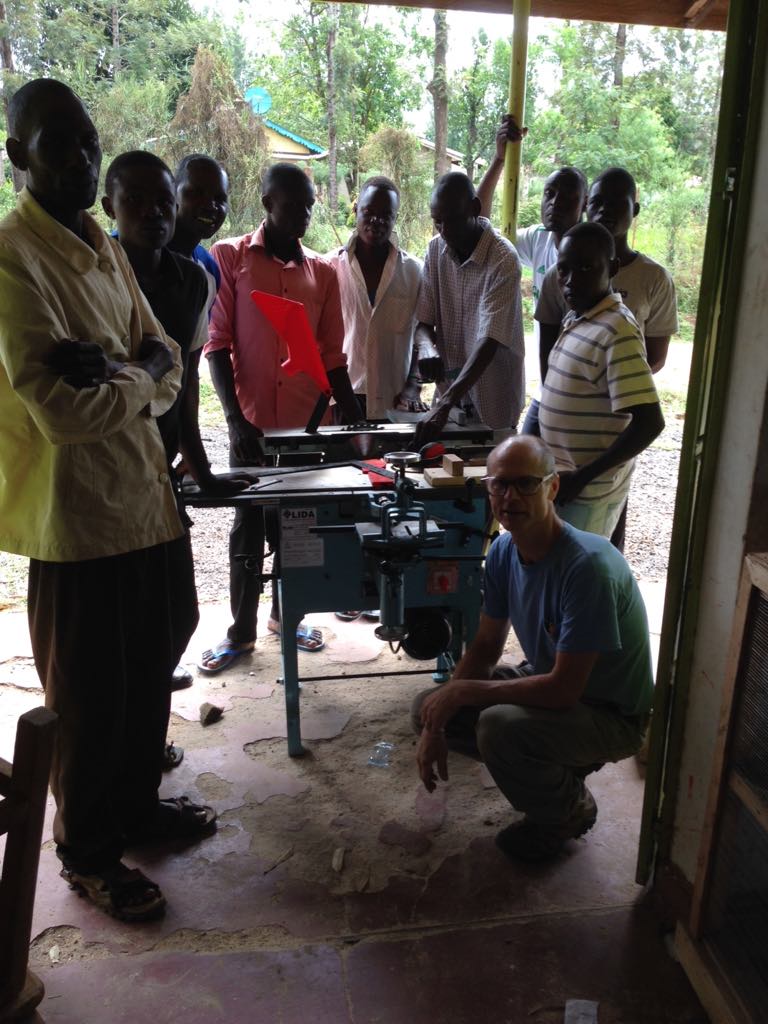
The purpose of our trip was to help teach vocational skills. Specifically, with Naomi helping in tailoring program and I helping with the carpentry program. Moving the carpentry program was a challenge for me. Although there is a teacher and the program has been in existence for some time, I found out that the students did not know how to measure anything. I bought each of them their own tape measure and worked with them on measuring accurately. Some days we seemed to move backward rather than forward.
One thing we were able to do, with the help of two generous donors, was to purchase a woodworking machine. This machine is four tools in one, and features a table saw, jointer, planer, and mortise machine. It should help the program in two ways: they no longer need to travel to a neighboring shop and pay them to plane their timber, and in the future, they plan to machine timber for customers and make a few shillings for the program.
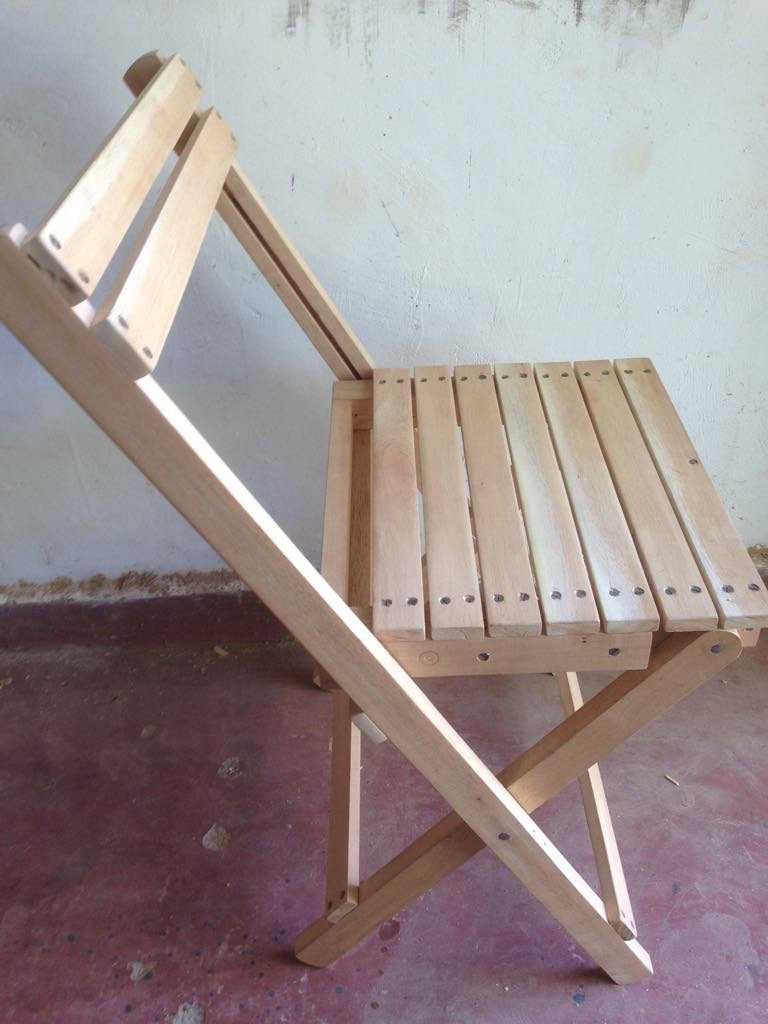
A project I was asked to take on was to design, engineer, and build a wooden folding chair. Plastic chairs are commonly used in the area and are problematic as they don’t store very well and easily break. During my time there, I was able to produce a prototype that is very far removed from the typical local chair. This version is light weight, folds easily, and flat. They should be able to produce similar versions for their library and to sell to others.
In contrast to my efforts, Naomi moved the tailoring program quickly forward. Her challenge was to produce a product that would be a good enough quality to be sold in the U.S. She had brought several new sewing supplies including pins, scissors, and a cutting system. With the better tools, they were able to produce a variety of good quality zippered bags.
Although she had some days of moving one step back, she moved forward quickly, that is until she got malaria. The area we were in is prone to many diseases. Naomi had not been feeling well and on February 28 she was so sick we took her to the hospital twenty minutes away. I could write a lot to describe the conditions at the hospital, but let’s just say it was very much a third world facility.
On the day we visited the hospital for the third time, Naomi and I were on the back of a boda boda when our driver, Joshua, came to a check point. Travel on a boda boda (motorcycle) was our common transportation when it was too far to walk. Boda boda drivers are required to have insurance, a license, and to wear a helmet. Police checkpoints and roadblocks are common ways for the police to enforce those laws. I don’t think Joshua met any of the requirements, so he decided to try to run around the police.
As we approached the check point, the officers began waving their batons. But we went faster. Next came the spikes in the road. But we went even faster, weaving to get around the spikes. Then came an officer with a machine gun, running towards us and shouting. Joshua just went faster. We made it through, no helmet required. No bike impounded. No shots fired. No worries. Naomi thought it was fun. I was less impressed.
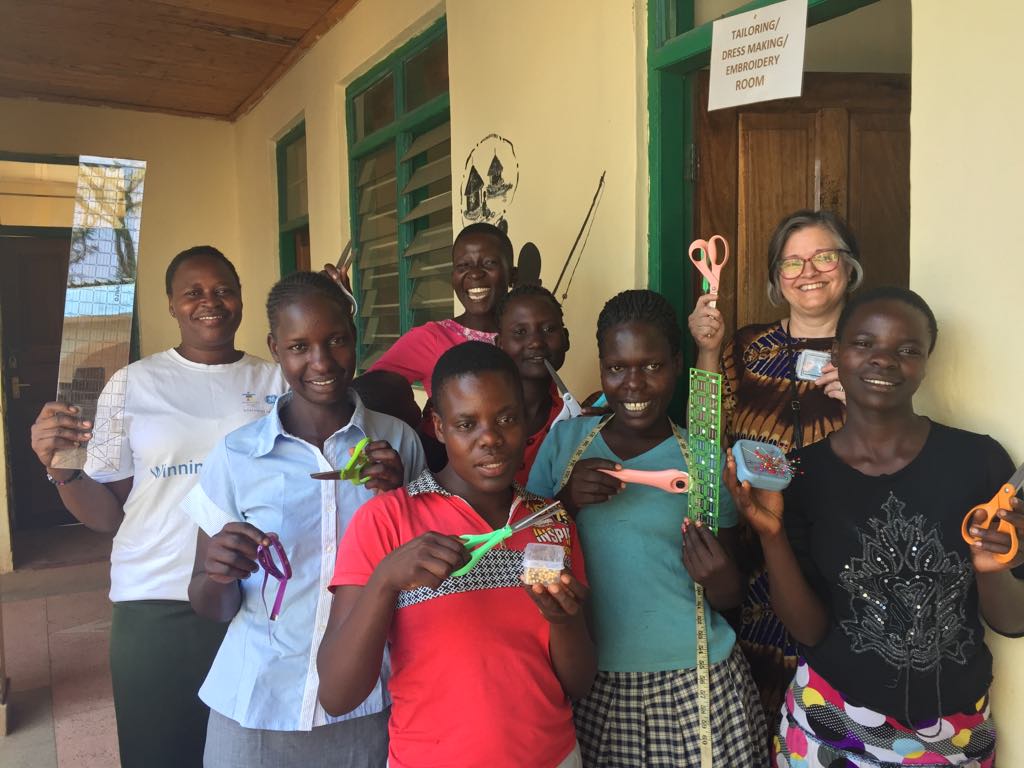
After four trips to the hospital and a few weeks of being sick, the end of our stay in Kenya was very difficult for her. Fortunately, Naomi had made great progress with the tailoring program in the early weeks of the trip. It was evident that she impacted her students, on our last day a student with tears expressed her heartfelt thanks for teaching them so much.
Due to Naomi’s health we cancelled our visit to India. There was no way she was strong enough to go from one very difficult place on earth to another one. On our last day in Kenya I had to take Naomi to the hospital for the fourth time. Malaria was still in her body. After getting her back to our room, I had a project I had to try and finish. This meant another boda boda ride to the Uganda border. I had ordered six pieces of glass the day before and only one was the correct size (measuring seems to also be a problem for glass cutters). As I made my way to the border, my mind was flooded with thoughts past and present, thoughts of when I was 19 years old and God spoke to me through Isaiah that I would be a light to the ends of the earth.
With tears running down my face it was very real to me once again that going to or spending time at the end of the earth is not easy. Naomi was so sick with malaria that she could hardly walk. Earlier at the hospital, I had stepped on the scales and discovered that I weighed 141 pounds. I don’t think I’ve been that thin since I was 11 years old. (I was a rather husky boy.) This mission hasn’t been easy, but God has been faithful to guide and restore us.
Over the course of the trip, there were several instances where God made himself incredibly evident. The first instance was that Naomi had made two baby blankets and brought them to Kenya. She gave one blanket to one of the tailoring students but wasn’t sure what to do with the other one. Each evening we would try to go for a walk around the village. We would often see a woman named Lucy who was not only expecting child but was also very friendly to us. Naomi gave Lucy the blanket and not many days later I saw Lucy and her newborn baby on the back of a motorbike. That evening we went on a walk to find Lucy and her new baby Shawn. Naomi got to hold Shawn, and afterwards we prayed a prayer of blessing over the home. Lucy’s husband Francis commented how humbled they were that we would give a blanket to them and come and visit.

Another instance of God’s guidance came when I became friends with Okiyo. Okiyo has been with Kiwimbi for several years teaching art. When I came, they asked him to make a switch to the carpentry program. It was a joy to work with him. As an orphan, Okiyo was raised by a family of drunks. He lives in a village an hour away from Kiwimbi by bicycle. As I got to know Okiyo I heard how he became a follower of Jesus Christ. I also learned that the church he is a part of needs Bibles.
While Naomi is down with malaria, and I felt the need to go see what I could do to supply some Bibles to Okiyo’s church. I asked Joshua the boda boda driver to take me to the Uganda border town of Malaba. There I go to a book shop and am surprised that the shop owner is a Hindu. I have never bought Bibles from a Hindu before, but they work just as well as any Bibles purchased from a Christian.
The next day, Sunday, Joshua and I begin our journey to Okiyo’s church. After 30 minutes of travel and stopping to ask directions we arrive at the church. It is a small structure made of sticks and mud. Large portions of the wall are missing, and the tin roof has many holes which makes for very creative patterns of light on the dirt floors. I have been in other African churches constructed with brick and tin, but this was certainly the worst conditions of a church that I have ever visited.
As the worship begins the only musical instruments are the clapping of hands and one plastic water container that also works as a drum No soft seats, light or sound systems, climate control, it wasn’t even in English, but God was there. During the service I learned that my visit was the first by a muzungu to the community and that they were very happy to receive the Bibles.
When church was over, I was invited to Okiyo’s home. He lives with his wife and five children in a typical African structure that is very small. There is no electricity or running water. Water itself is very limited. Okiyo takes me to visit the community well that is only three feet deep with an inch of water in the bottom. This is the well where people slept next to it in hopes of getting enough water to survive. It is a tradition to slaughter a chicken when a guest arrives. Our meal is chicken and ugali (ground corn maize). The visiting preacher was also invited and had been praying for a Bible. He expressed that our meeting was a miracle. I would agree. He traveled 40 kilometers to get there and happened to be visiting on a date that I, a muzungu from 8,000 miles away, would bring Bibles to a village I didn’t even know existed.
Mark Twain said, “travel is fatal to prejudice, bigotry, and narrow-mindedness” (The Innocents Abroad/Roughing It). As I reflect over the past few years, and specifically this story, how can I not see the world differently? How can I be narrow-minded and bigoted about beliefs when a Hindu shopkeeper helps me to supply Bibles to a church in need? How can I be prejudiced to race or nationality when my African friend, who has nothing in comparison to everyone reading this letter, is willing to make a great sacrifice by slaughtering a chicken to feed me? These travels have changed me and how I see the world.
Our plans are to settle back in New York City for the summer months continuing to be used by God as He has positioned us in the past.
We certainly need your continued prayers and support!
Thank you,
Paul and Naomi
Read more newsletters about the Amagoro Carpentry Program here.
Read more newsletters about the Amagoro Tailoring Program here.
Read more newsletters about our contribution to improving access to water in Bitobo here.
 BLIP
BLIP 
One thought on “April 2019”